




Property teams don’t need more integrations. They need fewer steps in their day.
Proptech has spent the last decade building integrations. And we love to talk about them. Operators ask for them. Sales decks highlight them. In an industry built on fragmented systems, integrations are supposed to be the answer: connect the tools, move the data, reduce the mess, achieve operational excellence.
And yet, property teams are still switching systems to make a single decision. They piece together context the software should be handling.
The problem isn’t that proptech lacks integrations. It’s that most integrations don’t meaningfully change how work gets done.
Proptech doesn't have an integration shortage. It has a workflow problem.
To understand why this keeps happening, we have to look at the structure of the proptech ecosystem itself and how integrations fit into real operator workflows.
The Integration Reality No One Escapes
Residential rental software is extraordinarily fragmented.
Hundreds of specialized vendors exist across leasing, screening, payments, maintenance, analytics, compliance, and operations. Each solves a narrow problem well and almost all of them rely on integrations to be usable at scale.
The residential proptech ecosystem now includes well over 1,000 specialized vendors, underscoring just how fragmented the landscape has become. (Source: Propexo Residential Rental Proptech Market Map)
This level of fragmentation makes integrations inevitable. As categories splinter and point solutions proliferate, no single product can stand alone. Integration becomes the default path to relevance.
But fragmentation alone isn’t the full story.
Despite the explosion of vendors, day-to-day work in housing still revolves around a small number of property management systems (PMSs).
PMSs anchor leasing, operations, accounting, and compliance. They are where decisions ultimately get made, and where work must return to be completed.
For any new vendor, integrating with these platforms isn’t a strategic choice. It’s a prerequisite to participate.
That structural reality shapes how integrations get built. When hundreds of vendors are integrating into the same PMSs, the fastest path is horizontal integration: passing data back and forth, syncing statuses, and linking out to separate experiences. It scales. It satisfies procurement. It checks the box.
What it doesn’t do is change the work.
As the ecosystem grows more crowded and integrations multiply, the burden of stitching context together shifts from the software to the user. This is how proptech ends up rich in integrations and poor in workflow relief.
Horizontal Integrations vs. Vertical Integrations
Not all integrations are created equal. They generally fall into two categories.
Horizontal Integrations
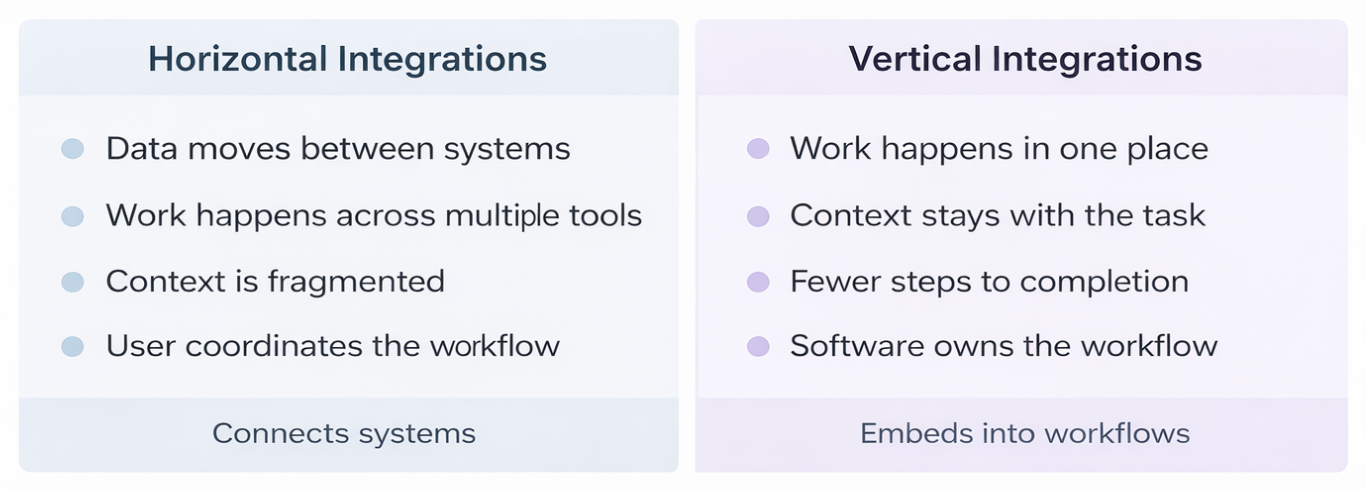
Most proptech integrations today are horizontal. They connect one system to another, moving data, statuses and where work happens. In practice that looks like clicking out to another tool, using another set of credentials, reviewing information somewhere else, switching tabs to finish a task, and manually deciding what to do next.
The integration technically works, but the work happens elsewhere.
Vertical Integrations
Vertical integrations behave differently. They don’t just connect systems; they embed functionality directly into the workflow property teams use every day. The decision and action happen in the same place, at the same time, with the same context.
No tab switching. No duplicate work. No mental gymnastics to connect the dots.
Here’s the test: if an integration sends you somewhere else to finish the work, it’s horizontal. If not, it’s vertical.
Before (horizontal integration): An application comes in, the property manager clicks out into another system to review & interpret screening results, then return to the primary workflow to decide what to do next.
After (vertical integration): The same application comes in, but screening results are now embedded directly into the system where decisions are made. The property manager reviews screening results and makes a decision, without switching systems.
Why This Matters So Much in Proptech
Multifamily and manufactured housing are operationally dense environments. Teams manage high application volumes, sensitive personal data, compliance requirements, and decisions that affect people’s ability to secure housing.
There is little tolerance for ambiguity, and even less for unnecessary friction.
In manufactured housing especially, teams tend to be leaner, systems more fragmented, and processes less forgiving of inefficiency. An integration that requires extra steps isn’t just inconvenient. It often goes unused.
When integrations fail to embed into real workflows, property teams compensate manually. They remember what lives where. They double-check work across systems. They slow down decisions to reduce risk.
“Property teams don't need more tech systems; they're looking for fewer steps. The most valuable integrations embed leading technology into the tools and processes they use every day.”
— Joe Easton, Director of Partnerships & Industry Relations, Rent Manager
That perspective reflects what onsite teams experience every day. The value of an integration isn’t in the connection itself, it’s in whether it actually removes work.
“Operators don’t need more tools — they need fewer steps. Integrations are how we streamline core processes, improve data integrity, and support scalability.”
— Ryan Hansen, VP of Product, Manage America
Taken together, these perspectives point to a broader shift in proptech. The most effective integrations aren’t the result of one vendor dictating an approach. They’re the product of teams designing around how work actually gets done.
In housing, integrations aren’t judged by how many systems are connected.
They’re judged by whether the job feels easier tomorrow than it did yesterday.
The Buyer vs. User Disconnect
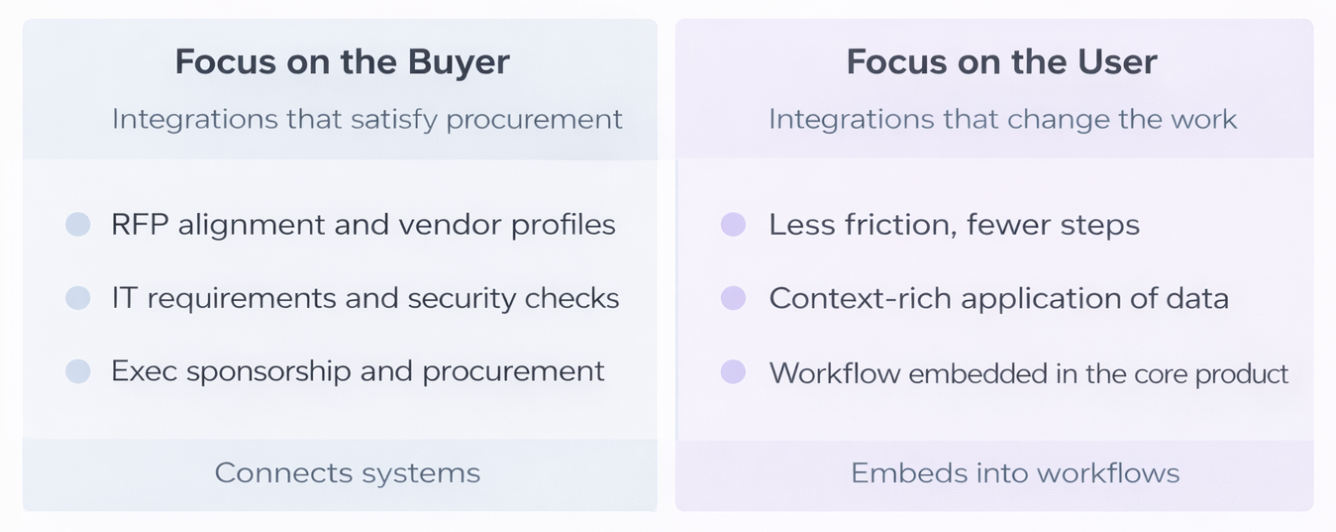
One reason this problem persists is that integrations are often evaluated by buyers but experienced by users.
From a buyer’s perspective, integration value is measured by coverage: which systems connect, how much data flows, how many boxes can be checked during procurement. From a user’s perspective, value is measured by effort: how many steps remain, how often context is lost, how much manual judgment is still required.
Those perspectives are rarely aligned.
A system can look fully integrated on paper and still add friction on the ground. That disconnect is easy to miss in demos, and easier to feel in daily operations.
“The automation and Rent Manager integration gave us back time, accuracy, and insight. We now make faster, data-driven decisions with full confidence.”
— Claudine Rivera, Director of Sales, Evoke Capital
What’s notable about that statement isn’t the mention of integration itself. It’s the outcome: time returned, decisions accelerated, confidence increased. That only happens when integration moves beyond data transfer and into workflow alignment.
Most integrations never get there.
They satisfy buying criteria without meaningfully changing how users work. And in housing, that gap quietly compounds into inefficiency, risk, and burnout.
The Future of Integrations in Proptech
The next phase of proptech won’t be defined by the number of integrations a platform supports. It will be defined by how deeply those integrations embed into the moments that matter.
The most valuable integrations won’t draw attention to themselves. They won’t require separate dashboards, extensive training, or process diagrams. They will feel native to the work.
In housing, the difference between a good integration and a great one is not technical sophistication. It’s whether the integration removes steps instead of rearranging them.
Proptech doesn’t need more integrations. It needs fewer, deeper ones, built around real workflows, real decisions, and the realities of housing operations.
For operators evaluating integrations, the takeaway is simple: stop asking whether systems connect, and start asking where the work actually gets done.